

Solar panels in winter typically produce less electricity than they do in summer, especially in Placer County where shorter days, lower sun angles, and occasional valley fog reduce available sunlight. Your system still works, and what matters most is how its year-round production aligns with your household’s electricity usage and utility rates.
If you’re considering solar for your home in Rocklin, Lincoln, or a nearby Placer County community, it helps to judge a system by its full-year production, not any single month. PG&E customers’ savings come from the whole year of generation, especially the long summer season when air conditioning drives usage highest. Winter is simply the quieter half of that annual picture.
Why solar output drops in winter
There are three main reasons seasonal production changes around Placer County and the greater Sacramento region:
- Shorter days mean fewer hours of sunlight. Panels have less time each day to generate electricity.
- The sun sits lower in the sky. Its rays reach the panels at a less direct angle, especially in the morning and late afternoon.
- Fog and clouds can reduce sunlight. Tule fog sometimes lingers in the Central Valley, cutting down production during already-short winter days.
A cloudy or foggy day doesn’t mean your panels stop producing altogether. They can still generate electricity from daylight, but typically less than on a clear day. Rain can wash away some surface dust, though it doesn’t make up for reduced sunlight.
What winter production looks like compared with summer
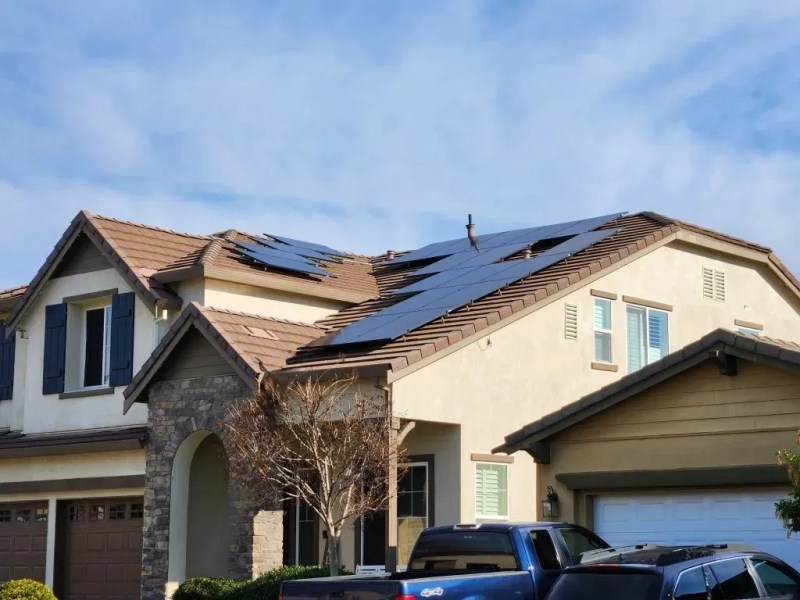
Understanding how solar panels in winter perform compared with summer can help Placer County homeowners set realistic expectations for their system’s year-round electricity production. Modeled data for the Sacramento area, which is generally applicable to Placer County as well, suggests average daily winter production of roughly 2.8 kWh per installed kilowatt, compared with about 8.5 kWh per kilowatt on a summer day. That’s approximately one-third of summer output. It’s a general seasonal estimate from that modeled data, not an expectation for any particular home: actual production varies by property, weather, shading, and system design. That’s why a real proposal should be based on your own roof and usage. Sacramento-area solar production modeling offers one example of a modeled seasonal profile.
This difference can be surprising if you check your monitoring app often. A long, sunny summer day may give your system many hours to generate power. A winter day may have fewer hours of sun, and fog can further limit generation. Even within the same month, a clear day and a foggy day can look quite different.
In PG&E-served parts of Placer County, including Rocklin and Lincoln, your utility bill also reflects when you use electricity and when your solar system sends excess energy to the grid. Under PG&E’s Solar Billing Plan, energy you export is credited based on its value at the time it is sent to the grid. Imports and exports are not necessarily valued the same way, so the amount your system generates is only part of the picture.
Some Placer County homeowners, including many in Rocklin and Lincoln, receive their electricity delivery through PG&E but their generation service through Pioneer Community Energy, a local community choice aggregator. The billing distinction matters for solar: time-based export credits apply when you send power to the grid during the day, while annual net surplus compensation applies when your system generates more than you use over a full year, and Pioneer pays that annual surplus at a premium above PG&E’s rate. Your contractor should confirm which arrangement applies to your address before you sign anything.
What winter means for system sizing and payback
A solar system is generally designed around your home’s expected use over the year, not to make every month’s production match every month’s electricity use. That matters especially in a place like Placer County, where a properly sized system needs to account for both the long summer cooling season and the shorter winter days. Sizing a system based only on summer use, or only on winter use, would give you the wrong picture either way.
When discussing system size, your contractor should look at your electricity use across the full year and any expected changes. A new electric vehicle, a heat pump, or a change in how many people are at home can all affect future consumption. Your roof’s sunny area and shade are important too. A good design estimate accounts for these factors and explains what it does, and does not, assume about seasonal production.
For PG&E customers, ask how the estimate handles the Solar Billing Plan’s time-based export credits and your home’s electricity-use pattern. Using some solar power while it is being generated can be more valuable than sending it to the grid and buying power back later. A battery can shift some daytime solar use into the evening, but it cannot make up for electricity the panels didn’t generate during an extended stretch of low sunlight.
Payback estimates also depend on assumptions beyond winter output, including utility rates, system cost, household use and export credits. Treat an estimate as a planning tool, not a guarantee. Ask the contractor to walk you through the assumptions and explain what could make your actual results differ.
Is winter a good time to install solar?
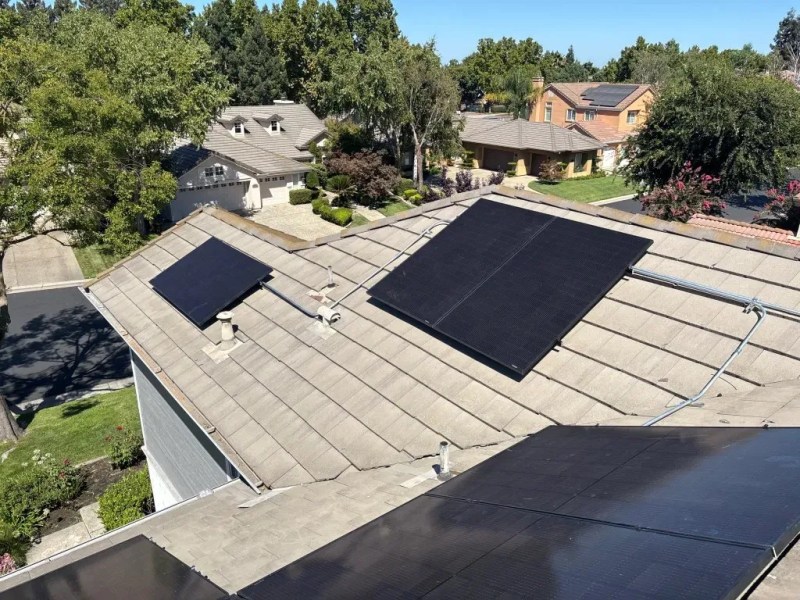
For homeowners considering solar installation in Placer County, winter is a good opportunity to evaluate electricity usage, compare solar and battery options, and prepare for the higher energy demands of summer. The season when a system is installed doesn’t determine how much it will produce over its life. If your roof is ready and the project schedule works for you, installing in winter may give you time to complete the design, permits, installation and utility steps before the next summer. The full timeline varies, so ask what steps remain and what could affect your project’s schedule.
Winter is also a practical time to look at roof condition. If repairs or a replacement may be needed soon, it’s worth discussing that before panels go on. Coordinating roofing and solar work may affect the project plan and timing.
Pairing solar with battery storage is worth a conversation too. For PG&E customers in particular, a battery can shift daytime solar into the evening peak hours when rates are highest, and can keep essentials running during a power shutoff. It’s a design decision that depends on your usage pattern and goals, and it’s easiest to plan for alongside the solar system itself rather than adding it later.
Two tax points are worth knowing as you weigh timing. The IRS says the federal Residential Clean Energy Credit is not available for qualifying residential solar expenditures made after December 31, 2025, and paying earlier or signing a contract isn’t enough if the original installation is completed after the cutoff (IRS guidance). Separately, California’s active-solar property tax exclusion is scheduled to become inoperative on January 1, 2027; systems that qualify for the exclusion before then remain excluded until a change in ownership (Board of Equalization guidance). Signing a contract before December 31, 2026 doesn’t guarantee eligibility: the installation must be complete and meet the applicable qualification requirements before the exclusion expires.
If you’re considering installing solar this year, the property tax change is worth understanding, but it shouldn’t be the only factor in your decision.

Questions to ask before moving ahead
A useful solar proposal should help you understand the design and the process, not just show an estimated annual total. Consider asking:
- How does the production estimate account for my roof direction, shade and seasonal weather?
- What electricity-use history and future changes did you use to size the system, including 12 months of usage data?
- How does the estimate account for PG&E’s Solar Billing Plan, Pioneer Community Energy if applicable, and my rate plan?
- What permits, inspections and utility steps are included, and what is the expected sequence?
- If my roof needs work, how would that affect the design and schedule?
- Would battery storage make sense for my home, and how would it change the design and cost?
A clear explanation can help you understand what to expect in winter, how the system fits your usage and which assumptions matter to the financial estimate. California Renewable Energy (CARE) handles the project lifecycle, including design, permits and inspections. You can learn more about our solar installation process and our approach to solar installation in Rocklin.
The practical takeaway for Placer County homeowners
Winter is a lower-production season for solar in Placer County, especially when short days coincide with valley fog in the lower elevations. That’s a normal part of a system’s yearly pattern, not a sign that it will produce at the same level in every season. Focus on the full-year estimate, your home’s electricity use and the way PG&E’s billing plan values imports and exports. If you’re considering a project, understand the timeline and the current tax rules before making a decision.
If you’re considering solar in Rocklin, Lincoln, Granite Bay, or another Placer County community within our service area, California Renewable Energy (CARE) can help you understand your options, the installation process, and the timeline involved. We provide clear, detailed proposals so you know what to expect before making a decision.
The most useful next step is a solar evaluation built around your home: your actual 12 months of electricity usage, your roof’s orientation and condition, and your utility rate plan, including whether Pioneer Community Energy or PG&E directly manages your generation credits. With those inputs, a design estimate can show you what year-round production and savings could realistically look like for your address rather than a county average. You can request a solar consultation with CARE to get a customized evaluation for your home.
Rank Math SEO title: Solar Panels in Winter: What Placer County Homeowners Should Know
Meta description: Learn why solar panels in Rocklin and Lincoln CA produce less in winter, how PG&E solar savings work year-round, and how proper sizing and battery storage affect your results.
Suggested URL: /solar-panels-winter-placer-county/