

Completed CARE solar array on a composition shingle roof.
Thinking about going solar but wondering if you should replace your roof first? Or maybe you already have solar panels and your roof is starting to show its age. Either way, the order matters. Replacing an aging roof before installing solar can save you the additional expense of removing and reinstalling panels later. And if your roof is still in great shape, there’s no reason to replace it just to go solar.
Throughout Sacramento, Placer, and El Dorado counties, we help homeowners determine whether it makes more sense to replace their roof before installing solar or work around an existing system. Every home is different, and the best approach depends on the roof’s condition, the solar equipment, and the homeowner’s goals.
Updated November 2026 — This article reflects current guidance on sequencing a roof project and a solar project for Sacramento-area homeowners.
Why the order of roof replacement with solar panels matters
A roof replacement involves removing and replacing roofing materials. A roof-mounted solar array sits on top of that roofing, attached through mounting points. If panels are already installed, they generally need to be removed before roofing work begins, then reinstalled afterward.
That means coordinating separate roofing and solar scopes. Depending on where you live, the work may also require separate permits. The practical effect is added scheduling and coordination, not necessarily a problem, but something to plan for early.
If you are planning a new system and your roof needs replacing soon, replacing the roof first usually avoids taking new panels off again for roofing work. If your roof is in good condition and has substantial service life remaining, solar may be the more straightforward first step.
The Advantage of Working With One Company for Roofing and Solar
Most homeowners end up managing two schedules, two contracts, and two sets of questions. Bringing both scopes to one contractor changes that in ways that are easy to underestimate.
The schedules line up. A roof replacement and a solar installation both depend on dry weather, inspection availability, and crew timing. When one company holds both calendars, the panel removal, the roofing work, and the reinstall get sequenced instead of negotiated.
There is one answer instead of two. Roof condition, mounting points, flashing, and waterproofing all sit at the intersection of these two trades. When roofing and solar are separate companies, that intersection is exactly where responsibility gets fuzzy. When they are the same company, there is one place to raise the question of who flashed what, and one explanation of how it is covered.
Warranties, permits, and inspections stay straight. You get one explanation of what each scope covers, one clear picture of who is pulling which permit, and one place to ask if something looks off after the work is done.
You avoid the cost of a second removal and reinstall later. Installing solar on a roof that will need replacing soon means paying to take those panels off and put them back when the roofing work happens. Looking at the roof and the solar plan together catches that before it happens, which is the whole reason this question comes up.
To be clear, we are not arguing that one company is always the right call. If your roof has decades of life left, there may be no reason to combine anything. But when both projects are on the near horizon, planning roof replacement before solar installation is usually the simpler path.
Start with the roof’s condition and remaining life
The Contractors State License Board (CSLB) says the average life expectancy of a typical residential roof is 15 to 20 years, and that age is usually the major factor in deciding when replacement may be needed. That general figure is not a prediction for an individual roof. Service life varies with the roofing system, installation, ventilation, maintenance, and climate. Modern architectural systems are designed for longer service lives than older or lower-grade systems. Read the CSLB roofing contractor guide for its consumer guidance.
Before you commit to roof replacement with solar panels, consider:
- The roof’s age and any available installation records
- Whether repairs have been needed repeatedly
- Active leaks, water damage, or ceiling stains
- Granule loss, damaged or missing shingles
- The condition of flashing around roof features and in valleys
- The condition of the roof deck, particularly if there are signs of moisture
These observations are considerations, not a diagnosis. Have the roof assessed before the solar design is finalized, and ask for the findings to be documented with photos. If you are weighing replacement, our guide to signs you may need a roof replacement and our roof replacement cost guide can help you prepare questions for a contractor. Have the contractor walk you through the assessment, photos, and proposed scope.

Roof replacement in progress featuring new architectural composition shingles.
If the panels are already on the roof and it needs replacing
When panels are already on the roof and the roof needs replacing, three things are worth knowing up front.
Solar removal and reinstallation may need a separate permit. In some jurisdictions, including Sacramento County, the PV removal and reinstall is treated as its own permit alongside the roofing permit. Sometimes a roof plan has to be submitted with it.
The right licenses have to be on the job. Roofing contractors are generally not licensed to remove or install a solar system. That work typically belongs to a licensed general, electrical, or solar contractor, which is why the two scopes are usually handled by two licensed trades even when one company coordinates everything.
Requirements vary by city and county. Sacramento County’s roofer guidance is not the same as Placer County’s or Roseville’s or any other jurisdiction’s. You can browse Sacramento County’s building forms and documents or call the county’s Building Permits and Inspection Division for its current re-roof and solar handouts, and your own building department can confirm what applies to your address. Confirm permitting and inspection requirements before the work is scheduled rather than after.
If your solar system is leased or covered by a power purchase agreement (PPA), contact the system owner before scheduling any removal or reinstallation. If your system is financed, review your agreement for any applicable requirements. You can also verify any contractor’s license through the CSLB license check.
What a new roof means for NEM 1.0 and NEM 2.0
Most homeowners we talk to are not worried about tariff language. They are worried about accidentally losing the billing arrangement they already have. Here is the short version of how it works for customers of PG&E and the other investor-owned utilities the CPUC regulates in this area.
The 20-year clock starts at interconnection, not at roofing. Under NEM 2.0, you are allowed to stay on the tariff for 20 years from the date your system was originally interconnected. That date does not move because you replaced your roof, so the clock keeps running on its original schedule.
Pulling panels and putting them back is generally not a modification. A like-for-like removal and reinstall for roofing purposes is not treated as adding generation. It is still worth asking your utility how it wants a reinstall documented, because the paperwork expectation is not identical everywhere.
Small capacity changes are often allowed. Under the NEM 2.0 grandfathering provisions, a modified or repaired system can generally stay eligible for the remainder of its 20-year period if the increase does not exceed the greater of 10 percent of the original nameplate capacity or 1 kW, and the system does not exceed your annual onsite load. That is the space in which a slightly different layout or a small addition can sometimes stay on the existing arrangement. Beyond it, the addition may need its own tariff treatment or the whole system may need to move.
A battery alone typically does not end legacy status. Adding battery storage to an existing NEM 1.0 or NEM 2.0 system does not by itself change your status. That said, some battery incentive programs carry their own tariff conditions. Participating in SGIP, for example, may require enrolling in the Solar Billing Plan depending on which budget category funds your project and whether an exemption applies, and PG&E notes that the switch could raise a solar bill because export credits are lower. Ask before you accept an incentive.
The practical takeaway is that a straightforward re-roof usually does not disturb anything, while a project that changes the size, layout, or equipment of the system deserves a specific answer in writing. Confirm it with your contractor and your utility before approving the work rather than after.
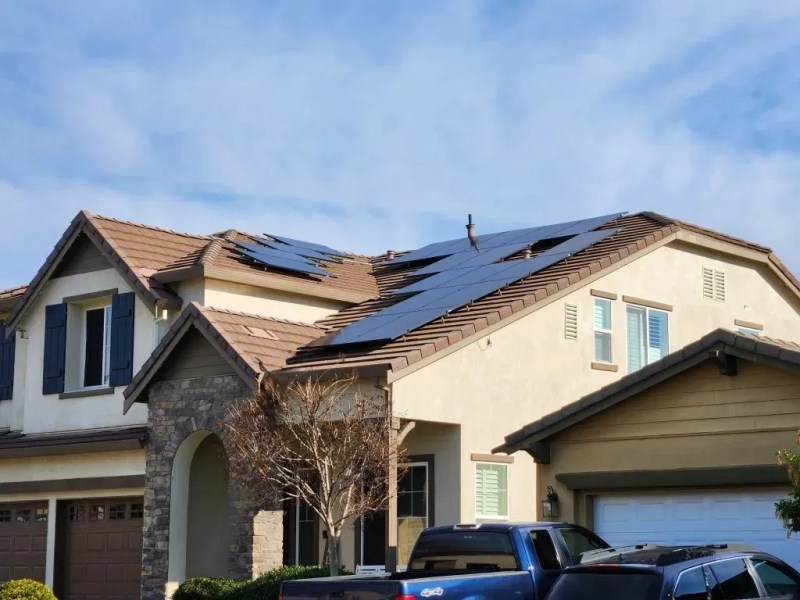
California Renewable Energy (CARE) solar installation on a tile roof in Lincoln, California.
A note on the federal clean energy tax credit
The IRS says traditional building components that primarily serve a roofing or structural function generally do not qualify for the Residential Clean Energy Credit. That covers components such as conventional shingles, roof trusses, and decking that support solar panels. Solar roofing tiles and solar shingles can qualify because they generate electricity.
The IRS also currently states that the credit is not available for property placed in service after December 31, 2025. For a system installed now, the federal credit is generally not part of the project math. Review the IRS Residential Clean Energy Credit guidance, and confirm your own situation with a tax professional. Do not buy a roof because someone promised you a tax credit for it.
Get clear on warranties and responsibility
Roof-mounted panels require penetrations through the roof covering. Roofing warranties commonly have exclusions related to work performed by others, while solar equipment warranties cover the equipment and typically do not cover the roof. The exact terms depend on the agreements and products involved.
Get both scopes of work in writing. Ask how roof penetration points will be flashed and sealed when the panels are reinstalled. Also ask each contractor to confirm in writing who is responsible if a leak appears at a mounting point. Clear responsibility makes it easier to address questions later.
Allow for sequencing, inspections, and weather
Roofing work is scheduled in dry weather when possible. During tear-off, parts of the roof are exposed, so rain forecasts and the work sequence matter. If panels need to be removed and reinstalled, that adds calendar time to the roofing project.
Plan for the roof assessment and inspections at the required stages, including final inspections. Confirm local permit and inspection requirements with the city or county responsible for your property, since Roseville, Rocklin, Lincoln, Auburn, and the unincorporated parts of Placer and El Dorado counties do not all handle re-roofs with solar the same way.

Completed residential composition shingle roof with ridge caps and ventilation.
A simple order for deciding
Work through these questions before you decide on a sequence:
- How much service life might be left in the roof?
- Are there active leaks or other signs that need professional assessment?
- Is the solar system owned or leased?
- Is the plan a like-for-like reinstall, or will the solar system change?
- What permits and inspections does your local jurisdiction require?
- How will the roofing and solar scopes be sequenced and inspected?
- What do both the roofing and solar warranties say?
Planning a Roof Replacement or Solar Installation? Let’s Look at Both.
Whether you are exploring solar for the first time, replacing a roof that has done its job, or pulling existing panels off so the roofing underneath can be replaced, the two projects are easier to get right when they are planned together.
California Renewable Energy (CARE) is a local roofing and home energy contractor that handles roof replacement and solar installation with one team, along with battery storage for homeowners who want it. We walk the roof, look at your usage and goals, and put together a clear plan covering the scope of work, the costs, an estimated timeline, and what the installation will require in permits and inspections. We provide fixed-price proposals so you know what you are agreeing to before anything starts, and we manage the project lifecycle through final inspection.
If you have been going back and forth on whether roof replacement before solar installation is the right order for your home, that is exactly the conversation to have with someone who can see both sides of it. When the honest answer is that your roof has plenty of life left, we will tell you that too.
CARE holds CSLB license #1068801 and has an A+ BBB rating, and works with homeowners throughout Sacramento, Placer, and El Dorado counties and across the counties and communities we serve. Request a roof and solar evaluation and we will look at your roof and your solar plan together before you commit to either one.